Lynmouth
The Salt PathLynmouth is both a destination and a measure of the difficulty of Ray and Moth’s early progress along the South West Coast Path. On their first days out from Minehead, the route toward it turns a guidebook’s understatement into a physical ordeal: steep woodland gives way to an exposed cliff, a gale and fog. They do not simply pass through a landscape on the way to Lynmouth; the terrain sets the pace, tests Moth’s balance and shoulder, and makes shelter an urgent practical question.
The approach from Minehead
Ray and Moth began the 630-mile walk in early August, after losing their home and becoming truly homeless. At the start of the path in Minehead, they hesitated before taking their first step, then set off in the afternoon with excitement and fear alongside the knowledge that they needed somewhere to go. Their resources were limited: after the journey to Somerset and bus fares, they had fifty pounds left, with a small weekly payment expected to provide what came next. That precarious beginning gives the approach to Lynmouth its stakes. The walk was at once a chosen purpose and a response to having nowhere to return to.
The first steep ascent above Minehead quickly exposed the difference between a route description and the ground beneath their feet. Sitting on a bench with a glimpse of the sea through the branches, they reread Paddy Dillon’s guidebook. Its description of the path as drifting a little inland and uphill did not match the climb they were making. The discrepancy recurs in the journey’s geography: a map or guide can name a route, but the body learns its actual gradients, delays and risks one step at a time.
A destination measured against the day
On the narrow path above a ravine, Ray and Moth encountered walkers who were already behind schedule and expected to reach Lynmouth by four. There was barely more than three feet of level ground between the cliff above and the drop below, so Ray and Moth’s stop to make tea briefly obstructed their passage. The encounter places Lynmouth not merely as a name on the route but as a deadline imposed by another walking rhythm. The other pair hurried on apologetically; Ray and Moth, with their packs and limited reserves, continued at the pace their bodies allowed.
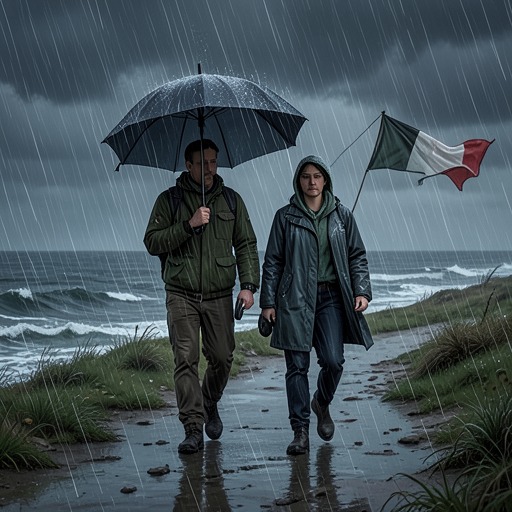
Beyond the woodland, gentle rain became a gale blowing in from the Bristol Channel. Their waterproofs flapped, water obscured Ray’s sight, and the weight of their packs caught the wind on the exposed cliff path. Near Foreland Point, a rainbow appeared against the colours of the hills, but the weather closed in again. Moth clung to the grass to steady himself as fog swallowed the view of the sea and left them unable to tell whether the narrow track lay on a slope or beside a sheer edge. In these conditions, the landscape offered no reliable visual horizon; a church tower emerging from the fog became the sign that they had found a nearby refuge.
Shelter, expense and a night above the cliff
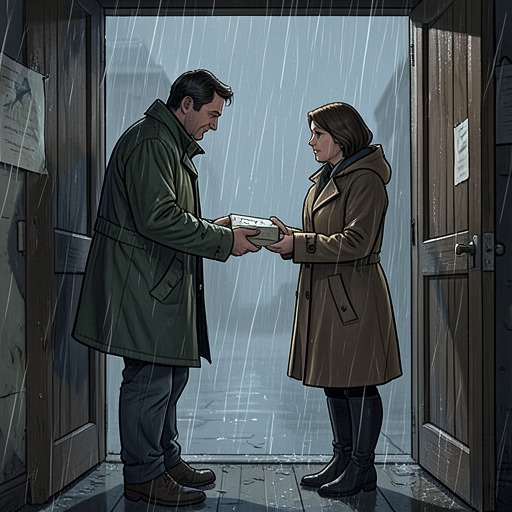
Moth’s shoulder was in agony from bracing against the wind, and his leg began to buckle. He fell into a pew at St John the Baptist, and they considered spending the night in the aisle. Instead, they crossed to the Blue Ball pub, arriving soaked and leaving puddles on the floor. The barman welcomed them in, and they collapsed on a sofa beside a log fire. Even indoors, money shaped what comfort they could accept: Ray could not rationally afford to buy anything substantial, so ordered a pot of tea, the cheapest option. A large dog carried off one of Ray’s socks, leaving a hole in it before Ray retrieved it. The small comic mishap sits alongside the larger discomfort of the day, without making their poverty disappear.
They stayed until eleven, when it was pitch black outside, then put up their tent in a niche in the cliff that offered slight protection from the gale. The night’s shelter proved precarious in the morning: the tent stood only two metres from the cliff edge, with a strip of grass between it and a hundred-metre drop. Fog had hidden the danger when they pitched it. Nearby, with no public toilet available, Ray had to use a clump of gorse; the practical indignities of sleeping outdoors were inseparable from the risk of the site.
Lynmouth as a point of passage
At daybreak, cloud lifted through Lynmouth Bay and poured over the headland. From the tent, Ray watched a dog walker disappear into the shifting cloud; a larger area of flat grass emerged from the mist, showing that they had walked past it during the storm. The view made the night’s choices visible in retrospect: they had found a place to stop and survived the wind, but had not been able to see the safer ground nearby. Lynmouth is thus associated with both shelter and exposure, with the route’s ordinary uncertainties made acute by weather and darkness.
The passage also establishes a pattern that shapes the wider journey. The path is understood through bodily effort, changing weather, small negotiations over money and the decisions required to continue or stop. Later, Ray describes walking as a rhythm in which hunger and pain can soften into an ache, and each completed climb or survived day supplies a reason to continue. That later understanding does not make the first approach easy: in the Lynmouth section, progress depends on stopping, accepting help, waiting out the rain and finding a place to sleep. The place’s narrative significance lies in this contrast between the apparent line of a coastal route and the difficult, contingent experience of moving along it.